
ROPA Method / CO-IFV
Have you ever wondered which options you have as a homosexual couple? As two mothers, can you both participate in the process of having a baby? The ROPA/CO-IFV method is here for you. ROPA method stands for “Reception of Oocytes from Partner”.
It is important to make clear that to be a mother is more than putting an egg or to give birth to a baby and that the ROPA/CO-IFV method is one in a millions options to become one.
What is exactly the ROPA method?
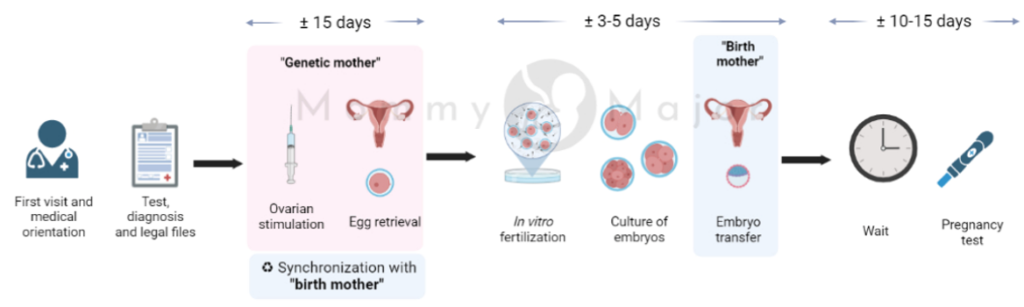
ROPA/CO-IFV method is an in vitro fertilization process for same-sex female couples. This method allows both women to be involved and share motherhood in a biological way. With this technique, one of them donates the eggs and the other one carries the embryo, both being mothers of the baby. Thus, there is going to be a “genetic mother”, the one that gives the egg, and a “birth mother”, the ones that gives birth to the baby.
How does ROPA/CO-IFV work?
This method consists of an In Vitro Fertilization (IVF) treatment in which the eggs from one woman are fertilized with a donor’s sperm and the resulting embryo is implanted in the uterus of the other woman. This way, both women are participating in the process of having a baby.
What does it mean to be the “genetic mother”?
The “genetic mother” is the one that gives the egg in order to generate the embryo but she will not become pregnant nor give birth to the baby. This means that the baby is likely going to have her DNA being highly likely that the baby is going to look like her.
Ovarian stimulation will be performed on the woman who will give the eggs to obtain multiple eggs as explained in the IVF post. Daily subcutaneous injections will be used as well as blood testing and periodic ultrasound monitoring to calculate when is the best moment to extract the ovules. This course of therapy typically lasts twelve days.
The egg collection is planned for when the doctor notices on ultrasound that the follicles are prepared. This quick intervention generally takes no more than ten to fifteen minutes and is performed in the operating room while the patient is sedated. Usually patients are required to be in the clinic two hours after the intervention under monitoring and then are allowed to go home.
The eggs from the “genetic mother” are then fertilized with a donor’s sperm. The donor is selected by the couple before the treatment starts. The selection of the male donor is made in accordance with stringent screening procedures that include mental, physical, and analytical examinations to rule out the existence of illnesses. Also, the greatest physical similarity to the “birth mother” is preferred (the other already provides her genetic information in the egg).
As further explained on the IVF post, the eggs and the sperm will be put together and multiple embryos will develop. From this, the doctor will select the most viable ones and implant them in the “birth mother”. The amount of embryos to be implanted have to be agreed prior to the IVF process with your doctor. Usually, if there is not any infertility issue, just one or two are implanted to avoid a multiple pregnancy.
What does it mean to be the “birth mother”?
Even though it might seem simple, the birth mother has to undergo hormonal treatment as well as the genetic mother. You may be wondering why and here is the answer. It is key for the success of the treatment the synchronization of the embryonic development in the laboratory with the preparation of the endometrium of the mother. Basically, the birth mother has to be on the correct stage in their cycle for the embryo to be correctly implanted.
Once both the embryos in the laboratory and the mother’s uterus are ready, the embryos are implanted inside the uterus through a simple and painless procedure. The same fay of the transfer, all the other embryos that are healthy but not implanted will be frozen in case this procedure is not successful or the couple wants to have another baby.
Between 10 to 12 days after the transfer, a blood test is performed to determine the presence of hCG, the hormone that activates the pregnancy test as we learned in the “how does a pregnancy test work?”. If the result is positive, means that the couple are pregnant and the pregnancy will continue like any other pregnancy.
How to decide which of us must be the birth mother and the genetic mother?
The decision about which partner will play which function, i.e., which one will contribute eggs and which one will give birth to the child is sometimes not easy. However, in many situations, just one of them wants to carry a pregnancy even if they both want to be moms.
In case that both of you want to carry a baby, the best approach is to decide which of you is in best shape to do it. The gynecologist will recommend the appropriate course of action depending on the qualities of both parties when both parties choose to carry and only want to have one kid.
Nevertheless, in couples that want to have more than one baby usually the oldest woman in the couple is the one that gets pregnant first since as the mother gets older, the riskier is a pregnancy.
Why should I choose ROPA/CO-IFV?
Although it is evident that biology is not necessary for a kid born in a family of two moms to be as much a child of both as in the case of the ROPA/CO-IFV technique, for many couples, it is the ideal way since it enables both mothers to become biologically connected.
With all the information you, as a couple, must choose the option that best suits your interest. It is true that if you do not need this “biological” connection with your child, ROPA/CO-IFV method is not needed. Is way more expensive than an artificial insemination and also more expensive than a regular IVF. As stated before, a mother is way more than someone that gives the DNA or that gives birth.
At the end the important thing is that you feel happy and fulfilled with your decision.
Second baby, how does it work?
You may be wondering if the expecting mother should be the same as in the first transfer when using frozen embryos from a previous ROPA/CO-IFV procedure to conceive a second child.
If there are no pregnancy-related contraindications, either mother may receive the embryos in the ROPA/CO-IFV procedure because the embryos are owned by the pair. However, if the second time the “birth mother” changes, the genetic mother and the birth mother will be the same leaving the other mother without this biological bond that characterizes the ROPA method/CO-IFV.
In case you want to do the ROPA method/CO-IFV again but with an inversion of roles, you have to start the procedure again for your second child.
Which are the requirements for the ROPA method / Co-IVF in legal terms?
In Spain it is mandatory for the couple to be married to perform the ROPA method. As long as the lesbian couple is married, both will be legally acknowledged as moms when they undergo assisted reproduction treatment and have a kid. Only the mother of an unborn child may currently be registered as a mother in cases of unmarried couples or unmarried partners; the non-pregnant mother must adopt a kid in order to be legally recognized as a mother.
In both the United States of America and the UK the couple doesn’t have to be married, however, if both mothers want to be the mother they must fill a Legal parenthood file before starting the procedure.
There are a lot of countries where the ROPA method (CO-IFV) is still not legal.