
Spermatogenesis
What is Spermatogenesis?
Have you ever wondered how sperm is created? Where do they come from? Are they constantly created or do men have storage? How do they move? Well, this and other very curious questions are answered below.
The generation of sperm is scientifically called spermatogenesis and it is a continuous process that occurs in the testicles. It begins at puberty and does not stop until death. In this process, spermatozoids are generated from germ cells, a type of stem cell.
What are stem cells?
Stem cells are the body’s raw materials, they are the cells from which all other cells with specialized functions are generated. Under the right conditions in the body or in a laboratory, stem cells divide to form more cells called daughter cells which after some divisions will become specialized cells such as sperm, miocitos (muscle cells), neurons, between others.
Stem cells, like most cells in our body, are diploid; that is to say, they have two copies of each chromosome making a total of 46 chromosomes. However, sperm (and eggs) only have one copy of each chromosome, they are haploid. This is because once an egg fuses with a sperm to create a new individual, there must be 46 chromosomes to generate an individual with a pair of each chromosome again in every cell: 23 will come from the mother (egg) and 23 from the father (sperm).
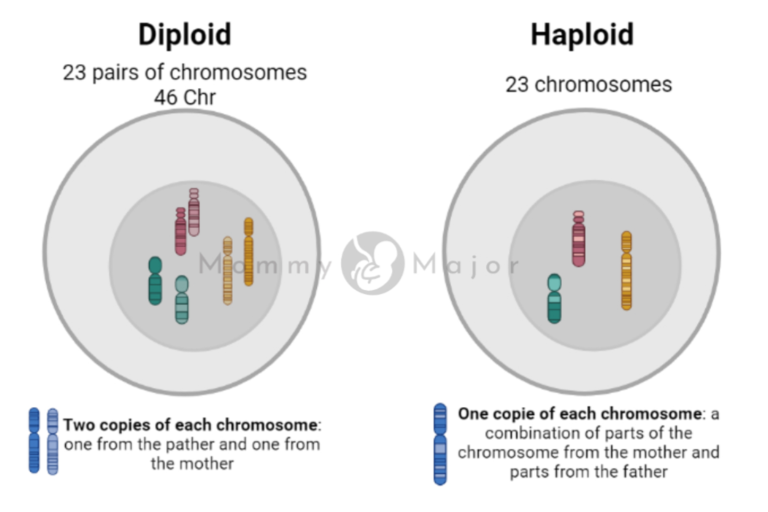
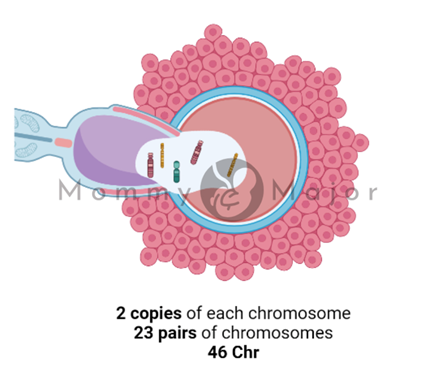
Actually, as we can see with the colors of the chromosomes, putting as example the pink Chr to be Chr 7, since we have one chromosome “7” coming from the father and one from the mother and, the chromosome from the father is a combination of genes from his father and his mother; Therefore what we actually have is 25% of chromosome 7 from our paternal grandfather, 25% paternal grandmother, 25% maternal grandmother and 25% maternal grandfather.
Okay, okay, I understand that sperm and ovules have to be haploids to generate a diploid individual but…
How can it be that haploid spermatozoa/sperm are generated from a diploid mother cell?
For this to be possible, meiosis is carried out, a process of cell division in which two haploid daughters are generated from a diploid cell, each of them will have one chromosome of each, there is no DNA replication.
- What is DNA? DNA is the molecule inside the nucleus of our cells that contains the genetic information responsible for the development and function of an organism. DNA can be found organized as Chromosomes.
- And DNA replication? What do you mean? DNA replication is a process that usually happens before cell division where the cell generates a copy of its DNA to be able to give each daughter a complete set of chromosomes.
There are very few stem cells in the body and for spermatogenesis to be effective and produce enough spermatozoids; before the meiosis process, two consecutive mitosis occur. In these mitosis, the mother cells are divided into two daughters, each of them will have the same chromosomal load as the mother, in other words, they will be diploid because there has been DNA replication prior to the division. Doing this mitosis prior to meiosis we achieve a higher number of sperm for each stem cell division, we get 16 sperm each time.
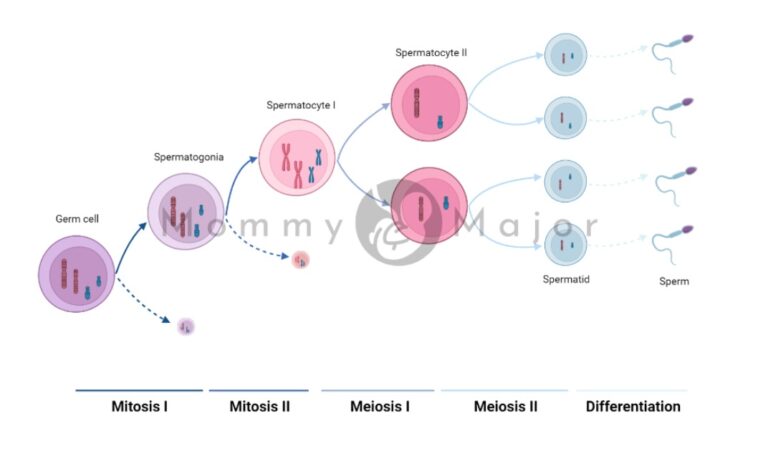
How do cells go from being round cells when they are spermatid to having this characteristic shape?
Once the spermatids are generated, they begin a process of differentiation in which, among other things, the organization of the parts of the spermatid (organelles) is remodeled to optimize its function.
Not only does it go from the typical circular shape that some of the cells in our body have, to the typical shape we all know of sperm, but also redistributes itself and changes the internal composition.
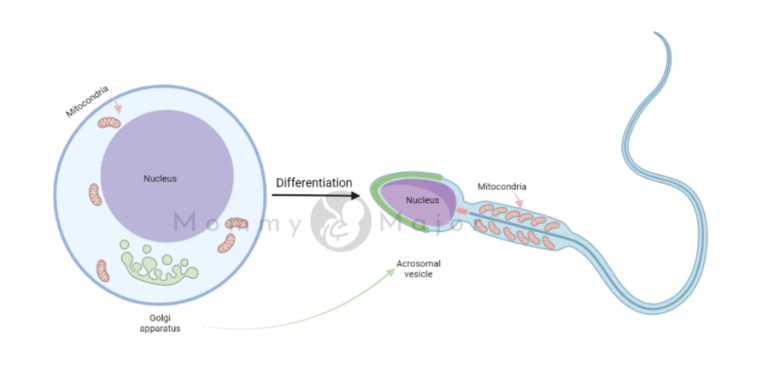
What do you mean by “it changes the internal composition”?
Cells have some organelles, little machines in charge of a specific function in the cells. Some of them are the same in all the cells and some others may change. In the case of the sperm, some organelles change its form and function, but remain mainly the same composition, and others just relocate to be able to perform better.
For example mitochondria are the energy engine of the cell and are usually found distributed in the cytosol (liquid inside the cells where the different organelles are floating). However, in the spermatozoid they are all grouped at the beginning of the tail so that all the energy is destined to propel itself towards the egg.
So, are you telling me that mitochondria are responsible for sperm movement?
Yes and no, they are the motor like in a car, obviously they are essential because they generate the energy for the sperm to move, but a car with no wheels would not move even having the best motor in the market. For sperm is the same, that’s why another remodeling that these cells undergo is the generation of a tail, responsible for the movement. Particularly, this tail allows the sperm to move in the seminal liquid like a fish would do in the sea.
In addition to mitochondria, we find that the Golgi apparatus, which is part of protein metabolism, disappears. Alright, it doesn’t really disappear, but it transforms into the acrosomal vesicle, which is at the tip of the sperm head and plays a key role in fertilization.
And that’s it? This sperm can go and fertilize an ovule?
Well, not exactly. These spermatozoa are already formed but on their own they are of no use; they still need to be capacitated. This process takes place in the female tract and allows the spermatozoid to interact with the egg.
When coming into contact with the fluids of the female reproductive system, a series of reactions occur where, for 5-6 hours, certain proteins are removed from the membrane of the sperm so that it is able to interact with the egg.
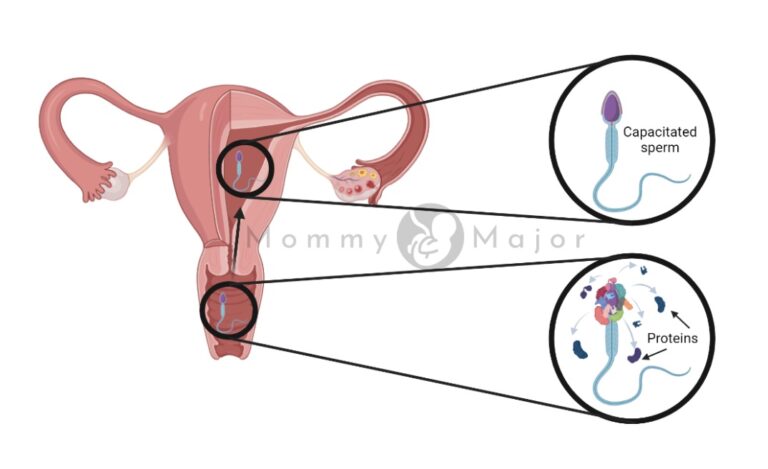
Okei so this happens after ejaculation, right?
Yes, exactly, once the sperm enters the woman’s body. And all the other processes? Where does it all happen? Inside the scrotum we can find the testicles where the spermatogenesis is performed.
But if the spermatogenesis is a continuous process, where does the sperm go to wait until ejaculation?
This is the ductus deference’s job, from the testicles the sperm travels through the epididymis, which is like a canal in charge of getting the sperm out of the testicle, to the ductus deferens which connects with the urethra. Finally, during ejaculation the sperm will come out through the urethra.
But are you telling me that semen is only sperm?
No! not at all! sperm is just the cellular part of semen. The sperm does not come out alone, between others, the prostate and the seminal vesicles are in charge of producing the liquid part of the semen where the sperm will swim.
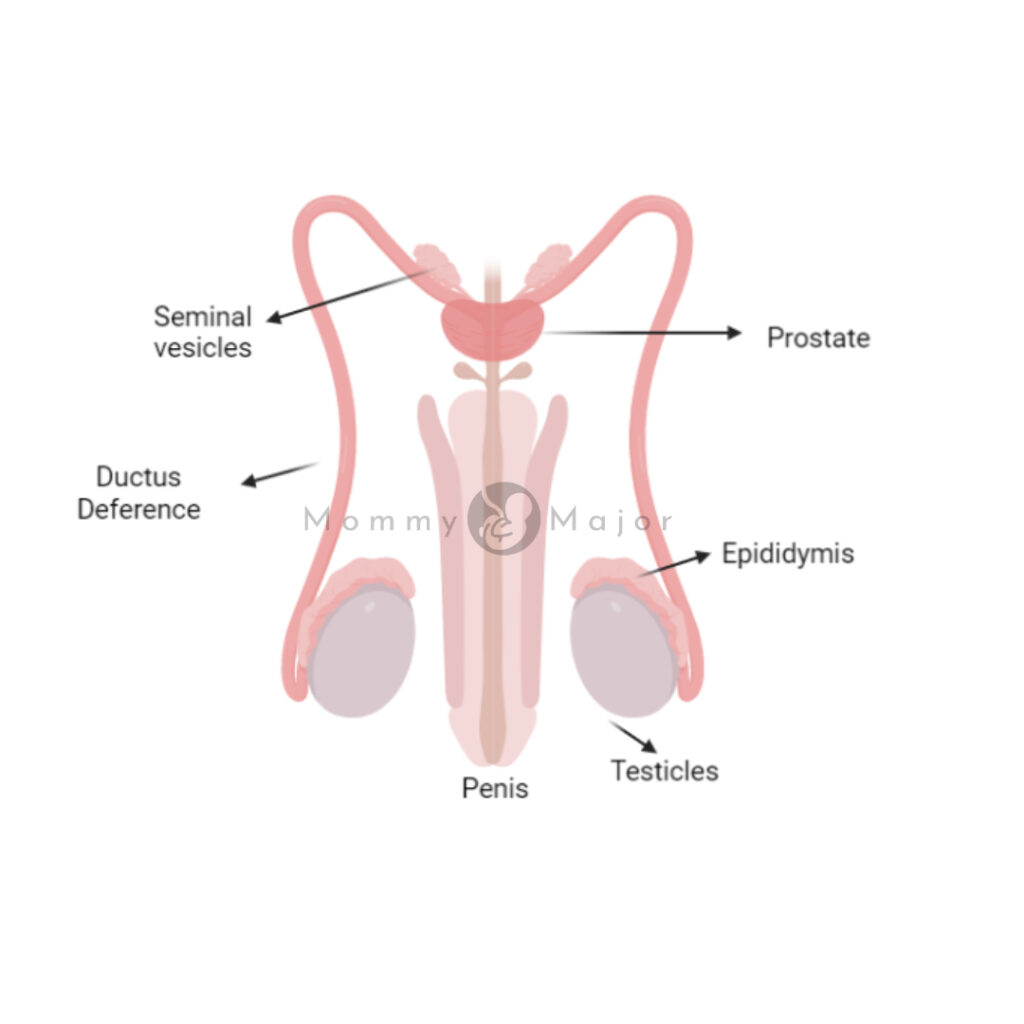
All this process of spermatogenesis must be done under very strict conditions. For example, the temperature.
Have you ever wondered why the testicles are outside of the body?
It feels unsafe and unnecessary to have them outside of the abdominal cavity when women do have the ovaries well preserved inside. This is for a reason. In order to keep sperm alive and to make sure that the sperm is created and differentiated correctly, the temperature of the ambient must be lower than 37ºC/98.6ºF, the body temperature, thus, putting the testicles outside, the body makes sure that spermatogenesis occurs under the correct temperature.
Consequently facilitaiting that the machinery in charge of producing sperm can work perfectly and that while the sperm is waiting to be ejaculated, it does not die.
Do you still have questions waiting to be answered? Do not hesitate a moment to write your questions below, we will be more than happy to answer your doubts!
Explore other Topics




The best books for pregnancy, reading only one booked we have seen that the confidence of the mother in herself and the process is highly increased. Whether you’re looking for practical advice, emotional support, or simply an enjoyable read to help you relax, this list has got you covered. So grab a cup of tea, curl up on the couch, and explore the best pregnancy books of 2023.

The Top 10 Breastfeeding Supplies Every New Mom Should Have