
Oogenesis
What is Oogenesis?
Have you ever wondered what is oogenesis? How ovules are created? Where do they come from? Are they constantly created or do women have storage? How do they come out of the ovary? Well, this and other very curious questions are answered below.
In the female reproductive system, the process is very different from spermatogenesis even though it looks similar. Really? Why? The main difference is that oogenesis is not an active process during life but occurs during embryonic development and is completed shortly after birth, leaving a reservoir of primary oocytes. From puberty and with menstruation, secondary oocytes are generated every month, these will only reach the state of mature ovules if they are fertilized.
Wait a minute, are you telling me that baby girls already have all the ovules that she is going to have for the rest of her life? Yes, exactly, we are actually born with all of our eggs but it is not until puberty that they start to come out of the ovary. A curiosity here is that any woman pregnant with a girl is actually carrying part of her future grandchildren since the ovules of the fetus are generated during pregnancy.
The generation of ovules is scientifically called ovogenesis and, as well as during spermatogenesis, eggs are generated from germ cells, a type of stem cell.
- But wait a minute, what are stem cells? Stem cells are the body’s raw materials, they are the cells from which all other cells with specialized functions are generated. Under the right conditions in the body or in a laboratory, stem cells divide to form more cells called daughter cells which after some divisions will become specialized cells such as ovules, myocytes (muscle cells), neurons, between others.
Stem cells, like most cells in our body, are diploid; that is to say, they have two copies of each chromosome making a total of 46 chromosomes. However, ovules (and sperm) only have one copy of each chromosome, they are haploid. This is because once an egg fuses with a sperm to create a new individual, there must be 46 chromosomes to generate an individual with a pair of each chromosome again in every cell: 23 will come from the mother (egg) and 23 from the father (sperm).
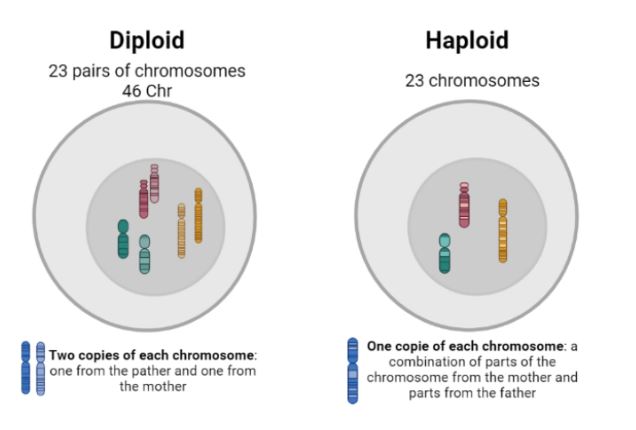
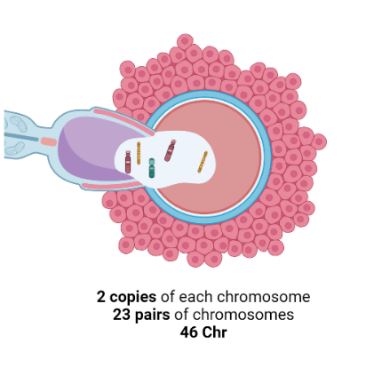
Actually, as we can see with the colors of the chromosomes, putting as example the pink Chr to be Chr 7, since we have one chromosome “7” coming from the father and one from the mother and, the chromosome from the father is a combination of genes from his father and his mother; Therefore what we actually have is 25% of chromosome 7 from our paternal grandfather, 25% paternal grandmother, 25% maternal grandmother and 25% maternal grandfather.
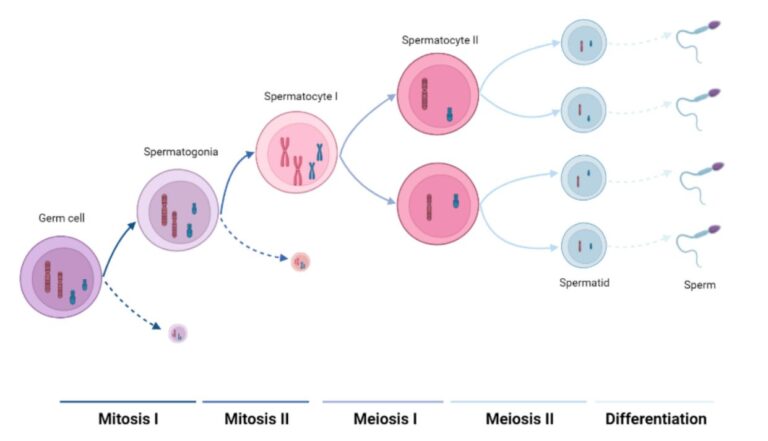
Okay, okay, I understand that ovules and sperm have to be haploids to generate a diploid individual, but how can it be that haploid spermatozoa/sperm are generated from a diploid mother cell? For this to be possible, meiosis is carried out, a process of cell division in which two haploid daughters are generated from a diploid cell, each of them will have one chromosome of each, there is no DNA replication.
-
- What is DNA? DNA is the molecule inside the nucleus of our cells that contains the genetic information responsible for the development and function of an organism. DNA can be found organized as Chromosomes.
- And DNA replication? What do you mean? DNA replication is a process that usually happens before cell division where the cell generates a copy of its DNA to be able to give each daughter a complete set of chromosomes.
There are very few stem cells in the body and for ovogenesis to be effective before the meiosis process, two consecutive mitosis occur. In these mitosis, the mother cells are divided into two daughters, each of them will have the same chromosomal load as the mother, in other words, they will be diploid because there has been DNA replication prior to the division.
Until here the process is almost exactly the same as it is for spermatogenesis. But here things start to change. How do things change exactly? Well, in ovogenesis division is not only conducted to get more ovules for each germ cell division, because we only get four ovules for each germ cell division, one for each primary oocyte (Oocyte I).
How can this be possible? This is because ovules need to get bigger in each division and for this to happen, instead of dividing into two daughters, during meiosis it actually divides into one oocyte and one polar body. At each division the oocyte will get bigger since it is keeping all the cytoplasm that should go to the other daughter (the polar body).
Uau! and why do ovules need to get bigger? The ovule must contain all the material necessary to start the development of the organism since the sperm only provides the genetic material and a centriole (necessary to locate the chromosomes inside the cell to ensure that when the cell divides are equally distributed between the two daughter cells). To achieve this goal, during the maturation of the egg it must grow a lot to collect all the necessary nutrients.
And what is the function of polar bodies then? Why does the ovule not only grow without division? Polar bodies serve to eliminate one half of the genetic material (meiosis) leaving behind a haploid cell, the ovule. If this asymmetric division would not happen, the ovule would never become haploid.
Okay, I am a little bit lost, can you sum it up a little bit? Yes! Of course! From the germinal stem cell, a mitosis is initiated, in this process the mother cells are divided into two daughters, each of them will have the same chromosomal load as the mother, in other words, they will be diploid because there has been DNA replication prior to the division is initiated. To increase the productivity of the reproductive cycle, just as in spermatogenesis.
This is how the primary oocyte is generated which undergoes a first meiosis, in this case asymmetric which gives rise to a primary oocyte with half of the genetic material and all of the cytoplasmic; thus generating a haploid giant cell and a vesicle called a polar corpuscle that serves to eliminate the other half of the genetic material. This primary oocyte enters meiosis again to give rise to the ovum.
How big is an ovule? You are going to find it hard to believe but ovules are actually the only cells that we can see without a microscope. Ovules are supercells with a cytoplasm/nucleus ratio 100 times greater than in the rest of the cells.
Uau! Amazing, now that we have a mature ovule it can come out of the ovule? No! We still do not have the mature ovule. The immature oocyte is the one that exits the ovary. This still has the polar body attached to the inner membrane. It is not until the egg is fertilized that the third polar body will be expelled, giving rise to the mature egg.
And, besides of the size, does the ovule change something else during ovogenesis? The ovule does not transform as much as a sperm does since it maintains its circular shape. However, it modifies parts of both the internal and external areas.
The most noticeably different part is the cytoplasm which increases in size 3 times. In addition, it gains parts such as the cortex which can be found under the cell membrane and has a gelatinous texture that facilitates the entry of the spermatozoid. Inside there are the so-called cortical granules that derive from the Golgi apparatus and help prevent polyspermy (the same egg being fertilized by more than one sperm).
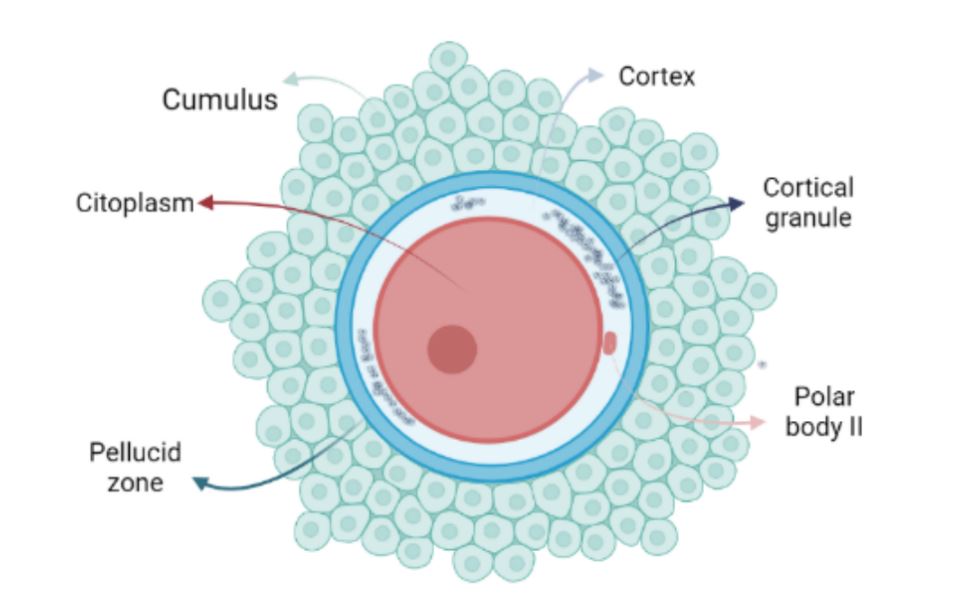
Finally, we find the vital cover also known as pellucid zone which contains some molecules (glycoproteins) in charge of species specificity (only a human spermatozoon can fertilize a human egg).
And now, how does the egg come out of the ovary? In order to answer this, we have to go into the menstrual cycle and ovaries functions.
Okay, I think I know this one, but which exactly is the ovary’s function? Ovaries play a critical role in both menstruation and conception. They produce eggs for fertilization and they make the hormones estrogen and progesterone. An ovary releases an egg around the middle of your menstrual cycle (around day 14 of a 28-day cycle) in a process called ovulation.
Each of your ovaries has thousands of ovarian follicles, we are born with them. Ovarian follicles? This is new! What are they? Ovarian follicles are small sacs in the ovaries that hold immature eggs. Each month, between days six and 14 of your menstrual cycle a hormone in charge of making your follicles mature is released, this is the FSH (follicle-stimulating hormone) which makes one follicle in one of your ovaries mature. At about day 14 in the menstrual cycle, a second hormone acts, it’s the turn of the LH (luteinizing hormone) that causes the ovary to release an egg (ovulation).
Does the ovary just produce FSH and LH? not really, between others, the ovary also produces estrogen and progesterone. What do they do? Estrogen is released during the first phase of the cycle and it is in charge of the ovarian follicles’ growth, while progesterone is produced during the second half of the cycle and it prepares the uterus for the future implantation of the fetus.
And does the ovarian follicle come out of the ovary with the ovule too? No! Actually the ovarian follicles are like little bags where the ovule rest until ovulation. When LH acts, this bag opens and expels the ovule. The rest of the bag is reabsorbed by the ovary until it disappears. However, before disappearing it goes through two phases: the fist one being the corpus luteum phase and the second the body albicans phase.
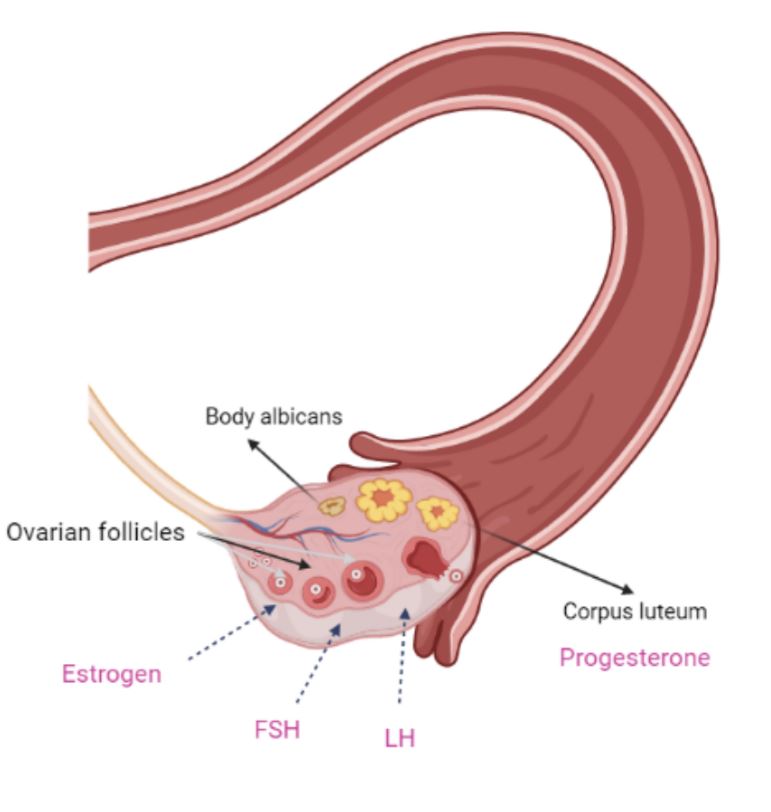
What do each of these phases do? Once the egg is expelled from the ovary the reminiscent ovarian follicle changes and it becomes the corpus luteum. Its function is to prepare the uterus for a fetus to grow since it releases progesterone. Once it’s no longer needed to make progesterone, your corpus luteum converts to body albicans which is just a remnant that will be reabsorbed. Usually part of the body albicans remains as a scar in your ovaries that can be seen through an echography.
And now that it is out of the uterus, what does happen with the ovule? The egg begins its travel through the fallopian tube, the structure that connects the ovary and the uterus, to the uterus. As the egg travels through the fallopian tube, the level of progesterone rises, which helps prepare the uterine lining for pregnancy. If you don’t become pregnant that cycle, the egg disintegrates and gets reabsorbed by your body so menstruation can begin.
And what if you do become pregnant? We will see what happens in the next chapter “fertilization”.
Do you still have questions waiting to be answered? Do not hesitate a moment to write your questions below, we will be more than happy to answer your doubts! We also encourage visiting trusted sites such as Pubmed.



Uau! That’s so cool, very interesting, I can’t wait to read more