
Pregnancy Test
How does a pregnancy test work?
Maybe you are trying for a baby or have recently had unprotected sex and are taking a pregnancy test when the question comes to your mind: how the hell does a pregnancy test work? Why should I trust this result? Do I have to take more than one? When should I take it?
Starting from the beginning, most of the time you can take a pregnancy test from the first day of a missed period. This is why, between other multiple reasons, it is so important to keep track of your cycle.
But, how do I know when to take a pregnancy test if I have a very irregular menstrual cycle or I do not know when your next period is due? In those cases, do the test at least 21 days after you last had unprotected sex. It is true that some very sensitive pregnancy tests can be used even before you miss a period but to be more sure of the results, wait a little longer to take it.
It is also important to know that it is not only important the day you take the test, but also the hour. As you will learn in a while, pregnancy tests work by sensing the quantity of a hormone in your urine, so the more concentrated your urine is, the better. But, when is my urine most concentrated? The best moment to take a pregnancy test is in the morning, during the first time you pee. This is because you have not either drunk water nor pee in at least 6 hours making your urine much more concentrated, this is why it is more yellow.
And how exactly am I supposed to take a pregnancy test? Well, there is not a predetermined way to do it but I would say that you can do it in two ways. The most famous one is also the simplest one, you just take the test and put it under your pee while you are peeing. However, some women find it difficult to do it this way so they collect their pee and then they put the test in the glass for 5-10 seconds. Either you have done it one way or the other, now it is time to wait. In the instructions of your test you will have the exact time for it is probably around 3 or 5 minutes until the result appears.
- The real result, the one you should trust, is the one that appears in 3-5 minutes. If the results change after 1 or 2 hours it is because the chemicals have oxidized or expired, it is no longer the real result!
And now, to the crux of the matter: how does pregnancy test work? They actually work similarly to covid test. All pregnancy tests detect the hormone hCG (human gonadotropin), which starts to be produced by the placenta around 6-9 days after fertilization. This is the moment when the embryo attaches to the uterus. hCG is essential for the function of the corpus luteum, a temporary structure in the ovaries that produces the hormones progesterone and estrogen. It has also been linked to early pregnancy symptoms, such as nausea and vomiting. hCG is eliminated in urine.
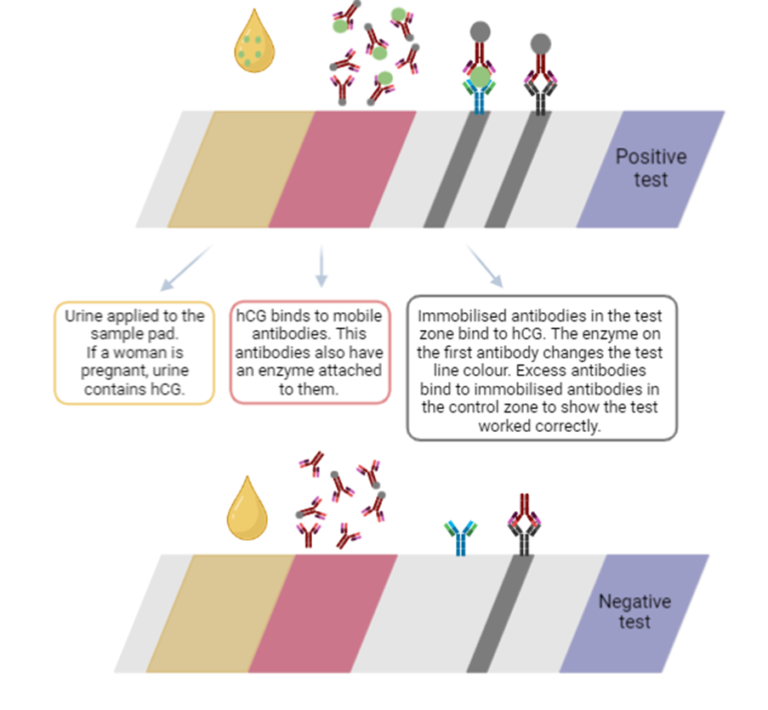
As we can see in the image a pregnancy test contain three main phases:
- Sample pad: it is the part from the test where the urine sample must go. Either if you directly pee to it or if you put the test in a glass with pee, you have to make sure that only this part gets wet. From here, the urine sample will go up through capillarity to the next phase. If you are pregnant your urine will have hCG.
- Mobile antibodies zone: in this phase there is a big amount of mobile antibodies that are meant to bind hCG. These antibodies have attached a color molecule. If you are pregnant the hCG will bind to the antibodies. Thus, part of the antibodies will have a molecule of hCH attached and other will remain free. There are more antibodies than molecules of hCH on the urine.
- Immobilized antibodies zone: In here we have two subzones:
- the positive line: in here we find immobilized antibodies that also bind hCG. This way, if you are pregnant, the hCG that is binded to the first mobile antibodies will also bind to the second immobilized antibodies.
- the control line: in here we find immobilized antibodies that bind to the first mobile antibodies. This is used to make sure that the test works and that the urine sample has led all the antibodies from phase two to the top of the test.
The color enzymes from the mobile antibodies will change the color of the lines where they have been attached. Consequently, if you are pregnant two lines will appear on the test whereas if you are not, only the control line will be marked.
Does a faint line in the positive zone of a pregnancy test mean I am pregnant or not? Yes, it does not matter how strong the line is, if there is a line, it is because your urine has hCG and therefore, you are pregnant.
How do I know if it is a false positive? And a false negative? Obviously the perfect test does not have either false positive or false negative, but since science is not exact and each patient is different, this is not possible. You may not know it but there are two types of rapid test (pregnancy test, covid test, …):
- Test with high sensitivity: This test has a very low ratio of false negative. As the sensitivity of a test grows, the percentage of ill people that test negative will slow down. Consequently, we make sure that everyone with the illness/situation that the test is meant to diagnose, are positive. This type of test is used as a screening, a first step into the diagnosis.
Exemple: This type of test is for example used to diagnose colorectal cancer in early stages. The test works by identifying a blood protein in fecal material of a healthy population. If the test is positive it means that you have blood in your stools, an indicator of colorectal cancer. When a person tests positive, the doctors do not assume that this person has colorectal cancer since this blood can come from a lot of other places, they have to run further tests. The next test is a test with high specificity, a colonoscopy, but since this second test is way more expensive and invasive, doing a first screening we are both saving money and saving people from having to go through a colonoscopy.
2. Test with high specificity: this test has a very low ratio of false positives. As the specificity of a test grows, the percentage of healthy people that test negative will slow down. Consequently, we make sure that only people that have the illness/situation that the test is meant to diagnose, are positive.
This type of test is used when a positive result is going to seriously affect the life of the tested person. For example, when the treatment for the illness is very hard. This is the case of both covid test and pregnancy tests.
- Pregnancy tests will hardly give you a false positive, if the result is positive you are pregnant.
Some cases where a pregnancy test can be positive without you being pregnant is for example if you just had a misscarriage. You still have high hCG in your urine but the pregnancy is no longer viable. Also, in men, a positive pregnancy test can indicate prostate cancer.
But, can a pregnancy test be negative and I still be pregnant? Yes, but it is not very common. Sometimes, if you take a pregnancy test too early it can turn out negative. Besides, it is possible that your level hormones are very low and the test is not capable of detecting them. However, this is not common at all.
Pregnancy tests have been on the market for a long time and they have been improving its specificity and sensitivity a lot. They are one of the most believable tests that we have nowadays.
This is for the traditional pregnancy test but what about the most modern ones that tell you how many weeks you have been pregnant? How does Clearblue work? The main mechanism is the same, this modern pregnancy test can tell you how many weeks have you been pregnant, also detecting hCG levels. The difference is that instead of working with color changing molecules attached to antibodies, this test works by using a smart Dual Sensor technology. There is no need to go into details but what this technology works on is not only detecting if you have or not hCG in your urine, but also detecting its concentration.
hCG increases after conception so detecting the concentration it is able to tell you of how many weeks you are. However, we have to take into account that, while the positive/negative result is 99% accurate, the accuracy of this other result given in weeks of pregnancy, depends on a lot of the women. The only truthful way to know how many weeks you have been pregnant is by an ultrasound by a doctor.