Fecundation & Pregnancy
Have you ever wondered how the ovule and the sperm come together to make an embryo?
Well, to begging with, it is important to know that the fertilization process takes place in two general phases: recognition, where current scientific knowledge believes that the egg chooses the sperm with which it will be fertilized; and the fusion where the sperm and egg go from being two haploid cells to generate two diploid cells.
What is this thing called recognition? What do they do? How does the egg attract the sperm?
Well, as we learn in spermatogenesis and oogenesis, the egg is 3 times larger than the sperm so it makes sense that this is the one leading the process.
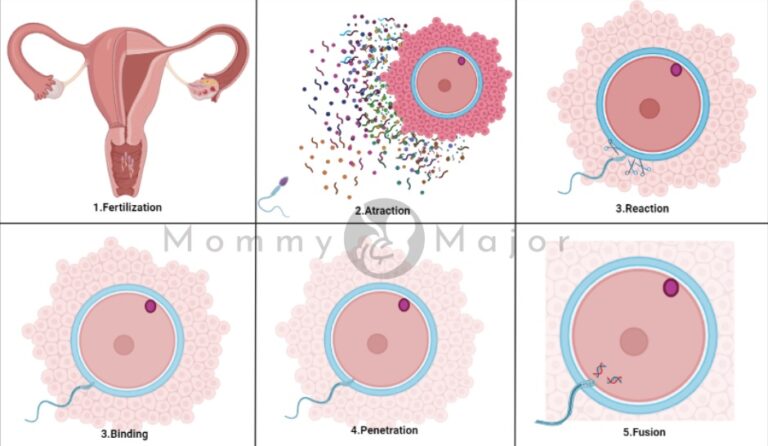
To go into more detail, the interaction of the sperm and egg takes place in six main steps:
- Fertilization: sexual encounter between a man and a woman where the sperm swims to the uterus.
- Attraction: the ovum is responsible for secreting molecules that attract the sperm towards it.
But how do these molecules attract the sperm?
These molecules create a gradient, a path. Thus, the sperm gets more of this molecule as close as it gets to the egg. The sperm is biologically attracted to these molecules since they give him energy so it’s going to want more and more so at the end it’s going to finish where the egg is, since that is where more molecules are accumulated.
3. Reaction: once the sperm comes into contact with the inner part of the pellucid zone (after passing the cumulus) the acrosomal vesicle of the sperm is released so that a set of molecules remain free (enzymes) that allow the union.
How do these molecules have anything to do with the union?
These molecules are called enzymes. Enzymes are in charge of breaking apart other molecules, they act as scissors. In this case not only are they going to allow the destruction of the pellucid zone creating a path for it to pass though, but sperm will also change the form of the sperm. The sperm is going to be more pointy, like a knife to be more powerful when penetrating the egg.
4. Binding: spermatozoid binds to the extracellular envelope of the egg (pellucid zone).
5. Penetration: the sperm penetrates through the cortex in order to get closer to the extracellular membrane of the egg.
6. Fusion: the sperm finally gets to the extracellular membrane of the egg and the two membranes, of the ovum and the spermatozoid, fuse, releasing the contents of the spermatozoa into the cytoplasm of the egg.
The molecules secreted by eggs to attract sperm are non-species specific and act in a gradient fashion. They generate a “path” towards the egg so that, the closer the sperm gets to the egg, the more molecules. These molecules act by activating the sperm so that it has more and more energy and, therefore, that it moves faster.
Once it has detected the egg, it crosses the cells of the cumulus and meets the pellucid zona. This area has proteins that alter the membrane of the sperm, causing the acrosomal vesicle to be released, allowing the sperm to cross the pellucid zone and the cortex, reaching the membrane. Once there, there is a specific key/lock system that will allow the fusion of the two membranes. At this point, the nucleus of the sperm is released (where the DNA is found in the form of chromosomes) and the rest of the cellular components are expelled.
Once the sperm has fused with the egg, it gives an immediate reaction to avoid polyspermy; that is to say, it prevents any other sperm from fertilizing that egg. This reaction consists in the release of enzymes in the pellucid zone that destroy the proteins that allow the release of the acrosomal vesicle from the spermatozoid, so it is impossible for any other sperm to fertilize the egg. In addition, not so immediately, the cortical granules are also released which degrade all the important proteins for egg-sperm recognition.
All of this is just recognition? Yes, exactly. So what happens during the fusion?
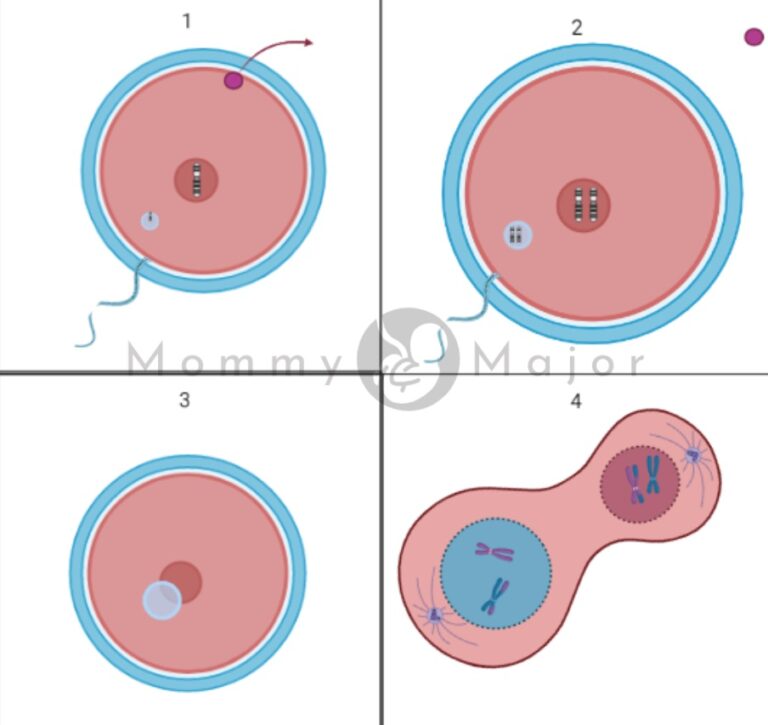
Remember that the ovule has stopped in meiosis II from the article about oogenesis and that, therefore, it has the polar corpuscle that must be removed. Once the nucleus of the sperm has entered the cytoplasm of the egg, the polar corpuscle is expelled. Next, the two nuclei, the one of the egg and the one of the sperm, begin to replicate their DNA (they make a copy of it to be able to give one to each daughter cell) as they approach each other so that, immediately after joining the two nuclei, the division into two daughter cells begins.
– Therefore, the diploid organism is not generated until the two-cell stage.