Ectopic Pregnancy
What is Ectopic Pregnancy?
Have you ever heard of an ectopic pregnancy? Are you wondering how it happened? Is it fatal? Or even if a baby can be born from an ectopic pregnancy?
All of this and even more is what we are going to explain in the following pharagraphs about ectopic pregnancy.
From the beginning, what is this thing called “ectopic pregnancy”?
As we already know from previous posts on fertilization, fertilized eggs are the first step in pregnancy. The fertilized egg normally adheres to the endometrium (uterus). However, it is not always like this, sometimes a fertilized egg can implant and develop outside the uterus’s main cavity resulting in an ectopic pregnancy.
Okay I get that but what do you mean by “outside the uteru’s main cavity”?
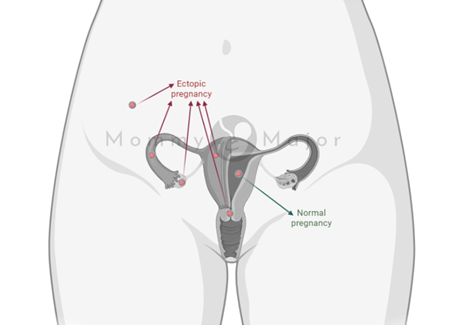
Where do ectopic pregnancies develop? Most frequently, ectopic pregnancies happen in a fallopian tube. Besides that, other parts of the body, such the ovary, abdominal cavity, liver or the cervix might occasionally have an ectopic pregnancy.
What causes ectopic pregnancies?
The most frequent type of ectopic pregnancy, known as a tubal pregnancy, occurs when a fertilized egg becomes impaled on its route to the uterus, frequently because the fallopian tube is inflamed or malformed and it slows down the course of the fertilized egg.
And what can cause this inflammation?
usually is due to unbalanced hormone levels, however, this can also happen if there is an infection. Regarding the malformation it’s usually something women are born with rather than something that develops with the years.
And what about other ectopic pregnancies, those that do not happen in the fallopian tubes? How do they develop?
It usually happens when the women have an open scar from where the fertilized egg can come out to the abdominal cavity. However, it can also happen that the fertilized egg doesn’t implant itself to the uterus and when it’s being eliminated it implants in the cervix.
And how do people know if they have an ectopic pregnancy? Which are the symptoms?
Initially, women might not experience any symptoms so the early stages of pregnancy may go without even noting that there is a pregnancy developing. In addition to not having specific symptoms, it is usually confused with a “normal pregnancy” since the typical early signs or symptoms of pregnancy, such as a missed period, breast soreness, and nausea, can also occur in an ectopic pregnancy.
If a fertilized egg continues to grow either in the fallopian tube, or anywhere else, it can cause some ruptures. This will likely start a heavy bleeding inside the abdomen which is one of the most life-threatening events that can happen and requires immediate medical intervention.
But does a pregnancy test also come out positive when it is an ectopic pregnancy?
Yes, all the hormonal part of the pregnancy is occurring fluently so the pregnancy test will come back positive. Even so, an ectopic pregnancy cannot proceed normally.
And how is it detected if it passes as unnoticed as it seems?
Usually one of these two things happen first: either the indications and symptoms get worse as the fertilized egg develops in the wrong location, there is pain and the woman starts to feel ill; or a transvaginal ultrasound scan is performed. One way or another an abdominal ultrasound must be done to confirm the ectopic pregnancy or evaluate for internal bleeding.
Does ectopic pregnancy have any treatment?
Lucky it does. Outside of the uterus, a fertilized egg cannot develop normally. For this reason, the ectopic tissue must be removed to avoid potentially fatal complications. Depending on your symptoms and the time the ectopic pregnancy is identified there are three types of procedure:
- The most popular kind of treatment for an early ectopic pregnancy without unstable bleeding is methotrexate, a drug that inhibits cell division and dissolves existing cells. The drug is administered through injection to only target the ectopic tissue. Before beginning this treatment, it is crucial that the diagnosis of ectopic pregnancy be certain. Your doctor will arrange a second HCG test after the injection to assess how well the treatment is working and whether you require further medication.
- When the ectopic pregnancy is in the fallopian tubes and it has begun to develop, either one of these two laparoscopic procedures, salpingostomy and salpingectomy, are used.. A small incision is created in the abdomen during these procedures, either near or in the navel. The area where the ectopic tissue is located is then viewed by tg doctor using a narrow tube called a laparoscope that is fitted with a camera lens and light. During a salpingostomy involves removing the ectopic pregnancy and allowing the fallopian tube to heal naturally. However, during a salpingectomy the ectopic pregnancy and the tube are both removed.
- If the ectopic pregnancy is resulting in significant bleeding you may require urgent surgery. The procedure can be carried either laparoscopically or via an abdominal incision (laparotomy). The fallopian tube may be saved in specific circumstances however, a ruptured tube must typically be removed.
Uau that sounds scary! Can an ectopic pregnancy be prevented?
Even Though it may be scary, if you have all your doctor appointments on time and you always explain all your symptoms, an ectopic pregnancy can be diagnosed early and the consequences will be very low. venthough ectopic pregnancies cannot be prevented there are some ways to decrease our risk such as limiting the number of sexual partners and using a condom during sex helps to prevent sexually transmitted infections and may reduce the risk of pelvic inflammatory disease and Don’t smoke.
I assume that as well as with another pof disease there are some risk factors for ectopic pregnancy, aren’t they?
Yes, of course. Unfortunately we cannot prevent ectopic pregnancies but we can be aware that we are at risk of having one. This information can help us to better identify the symptoms or to do early ultrasounds every time a pregnancy test comes out positive. Some of the risk factors are:
- If you have experienced an ectopic pregnancy in the past you are more likely to experience another pregnancy of this kind.
- Sexually transmitted diseases like gonorrhea and chlamydia can inflame the fallopian tubes and other surrounding organs, which raises the possibility of an ectopic pregnancy.
- According to some studies, women who undergo in vitro fertilization (IVF) or other similar fertility procedures may be more prone to experience an ectopic pregnancy.
- The chance of an ectopic pregnancy can rise following fallopian tube’s surgery to repair or ligate them.
- If you become pregnant while wearing an IUD, it is more likely to be ectopic. If you become pregnant after having your tubes tied, or tubal ligation, a permanent birth control treatment, your risk is also increased.
- The chance of an ectopic pregnancy can increase if you smoke right before getting pregnant. The risk increases with the amount of smoking since smoking increases inflammation.
For more information we recommend checking trusted scientific articles on websites like Pubmed.